

 by
by 
Federal Govt plan to make the Karachi’s Green Line project the world’s first zero emission public transit project, so no use of diesel or petrol to power the buses, but using biogas (is a mixture of different gases produced by processing organic matter, and can be produced from raw materials like agricultural waste, manure, municipal waste, plant material, sewage, green waste or food waste).
There will be 200 buses operating under this project, which will be the world’s first zero emission public transport service. Through this project, 2.7 million tons of carbon will be reduced.
The four-year project will cost an estimated $583.5 million. The Green Climate Fund, a subsidiary of the United Nations, will be giving $50 million – a $37.2 million loan and a $11.8 million grant. For the remaining amount, Fed Govt is talking to the Asian Development Bank and French Development Bank.
The government has decided to take a loan of $490 million from the Asian Development Bank (ADB) in order to fund the Karachi Bus Rapid Transit (BRT) project.
A month ago, Federal Minister for Communications Murad Saeed has informed the National Assembly that the Green Line Bus Rapid Transit System, Karachi is set to be completed before July 2019.
Saeed told the House that deadline for completion of the project is 30th June, 2019, but he avoided to take a categorical stance whether the project would meet its deadline for completion or not.
However, sources inside the Ministry of Communications are of the opinion that the project is unlikely to be completed according to the deadline of June 2019, which was given by the Federal Minister due to multiple reasons.
The project is solely funded by the federal government without any contribution by the government of Sindh in infrastructure development. However, the operation, maintenance of buses and installation of ITS equipment on Green line BRTS is the responsibility of Government of Sindh.
A dedicated company named Karachi Infrastructure Development Company was established by federal government and it was given the responsibility of laying the required infrastructure for the BRTS project.
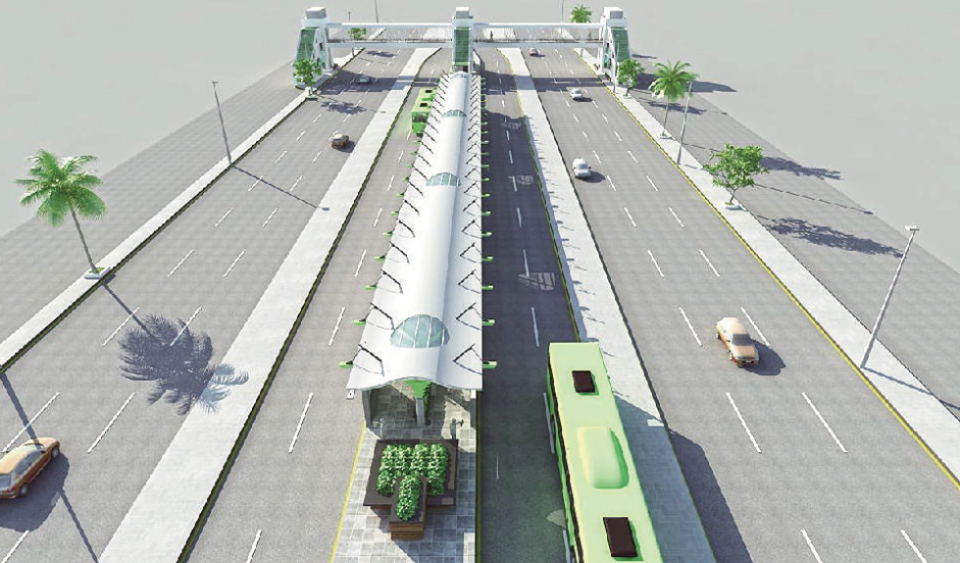
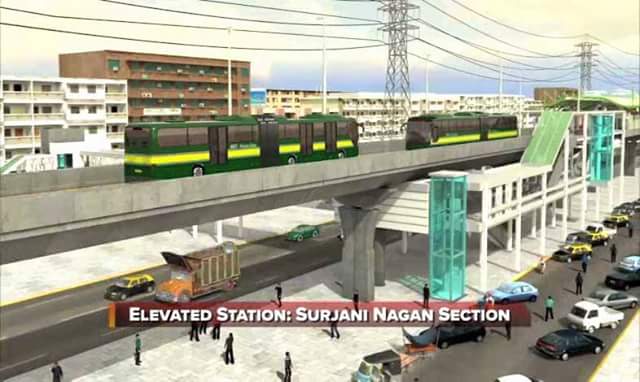
The project was supposed to be completed in 2 years but due to its redesigning and inclusion of 3.5kms phase two extension from Guru Mandir to Municipal Park near Sabri Nihari delayed its completion.
Sources said that the Finance Division would table a summary in this regard during the Central Developing Working Party (CDWP) meeting. Following the CDWP meeting, the matter would be placed in the meeting of Executive Committee of National Economic Council (ECNEC) for approval.
Sources said that ADB had also given $10 million to the Sindh government to conduct a feasibility study of the project.
It is pertinent to mention that the Sindh government in July this year had approved a resettlement plan for the construction of the BRT project, which was estimated to cost Rs227 million.
The documents stated the proposed project would help develop a sustainable transportation system in Karachi by delivering the city’s red line BRT corridor, directly benefiting 1.5 million people. The project would comprise two interlinked outputs: the construction of a 25-kilometre (km) BRT corridor and associated facilities, and effective project management and sustainable BRT operations through institutional developments.
The Green Line BRTS project which cost Rs25 billion was inaugurated by former Prime Minister Nawaz Sharif in 2016. The project starts from Karachi’s Surjani Town area all the way till Guru Mandir.
Out of the 17.8kms stretch of the Green Line BRT, 9.92kms are elevated and 7.88kms are on ground. There are a total of 21 stations along its route. It was envisioned that after its completion, the corridor will benefit nearly 300,000 passengers per day.
The project is economically justified as it would not only save the passengers’ time but would also save vehicle operating cost. Besides, the project aims to improve air quality and save carbon emissions, which will improve the health of Karachi’s citizens and help mitigate climate change. The project will also make Karachi safer, boost private sector investment, and foster gender equity.

Join The Discussion