

 by
by 
سوات موٹروے یکم مئی سے کھول دی جائیگی
Swat Motorway to be opened on May 1’ 2019 The decision to this effect was taken during a meeting of chief minister with the Federal Minister for Communication Murad Saeed.

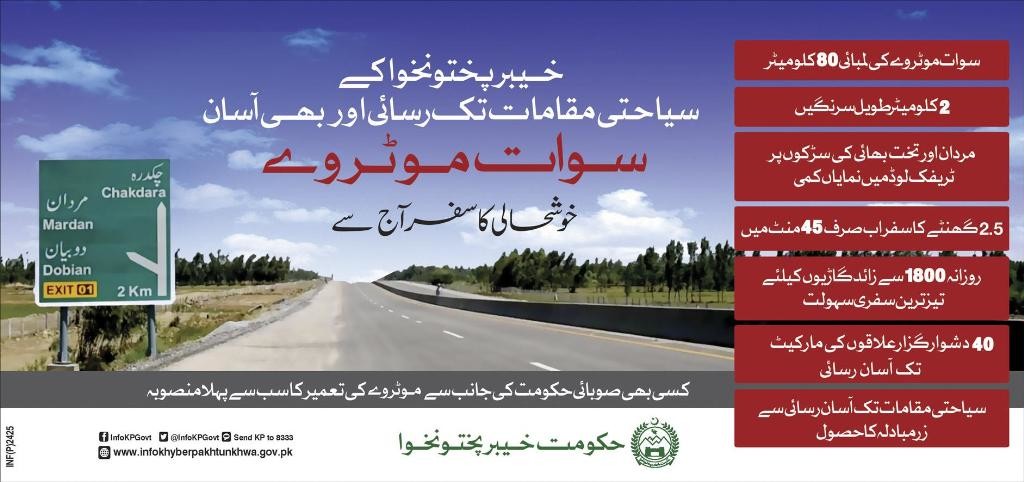
The expressway stretches from Nowshera to Chakdara in Lower Dir District, passing through Swabi, Mardan, and Malakand Districts.
Its is an 81-kilometre-long (50 mi) four-lane divided with 6 Interchanges, Motorway.

The project was inaugurated in August 2016 and is expected to be completed in 15 months. With completion of this project, the travel time from Nowshera to Chakdara (Swat) via Motorway, will reduce from three hours to one hour.
The meeting which took place at the Ministry for Communication Islamabad was also attended by the National Highways Authority Chairman Jawad Rafique Malik, Frontier Works Organisation Director General Maj Gen Inam Haider Malik, Pakhtunkhwa Highways Authority MD, Secretary Communication and Works, Secretary Irrigation, Project Director Swat Motorway and others.
The meeting reviewed the pace of progress on the Swat Motorway and exchanged views about the project. The meeting expected that the motorway would be ready by April therefore it decided to hold the inaugural ceremony for vehicular traffic on May 1.
The meeting thoroughly debated the extension of Swat Motorway and agreed to extend it for the integration of the whole Malakand division with the Khyber-Pakhtunkhwa.
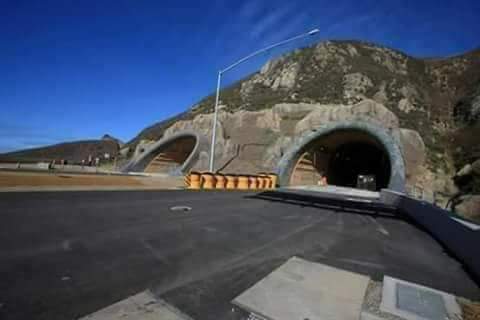
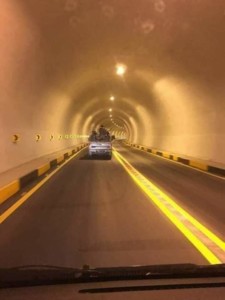
The route will be contributing towards development of the region. The motorway will connect Karnal Sher Khan Interchange on M-1 with Chakdara, tunnelling its way through the mountain at Palai and Ala Dhand areas.
Two kilometres of the road fall in Nowshera district, 18 kilometres in Swabi district, 40 kilometres in Mardan and 21 kilometres in Malakand.
The total right of way (ROW) of the expressway is 80 metres. According to FWO website, work is in full swing and will be complete by April 2019. The project was started in April 2017 with a cost of Rs34 billion.


Join The Discussion